 Nikhilesh Chavda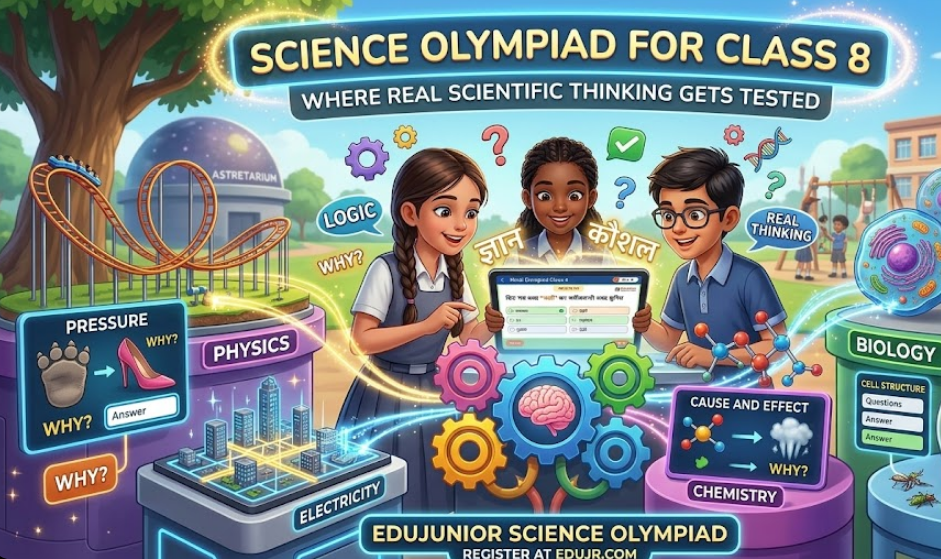
By Class 8, science becomes more structured and intellectually demanding. Students no longer study science as a single general subject. Instead, they begin exploring physics, chemistry, and biology as distinct branches, each requiring its own style of thinking and understanding. At this stage, success in science depends less on memorisation and more on conceptual clarity, logical reasoning, and the ability to apply knowledge in unfamiliar situations. A Science Olympiad for Class 8 is designed to test exactly these abilities.
It challenges students to think analytically, connect concepts across topics, and approach scientific problems with confidence and precision.
What Does a Science Olympiad for Class 8 Cover?
A Science Olympiad for Class 8 covers the complete science syllabus across physics, chemistry, and biology.
Physics topics usually include force, pressure, friction, sound, light, and electricity. The questions are application-based and often connected to real-life situations. Instead of simply asking students to define pressure, a question may compare how different objects behave on soft ground and ask students to explain the outcome scientifically. This approach tests whether students truly understand the concept rather than merely remembering textbook definitions.
Chemistry topics generally include matter, metals and non-metals, combustion, coal and petroleum, and basic chemical reactions. Students who understand the reasoning behind chemical behaviour usually perform much better than those who rely only on memorisation.
Biology sections commonly cover microorganisms, crop production, cell structure, reproduction, and conservation. These questions reward students who actively engage with concepts and understand relationships within biological systems.
The overall focus of the Olympiad is to evaluate scientific thinking, analytical ability, and conceptual understanding across all three branches of science.
Why Class 8 Is a Crucial Stage for Science Learning
Class 8 acts as a bridge between middle school science and the more advanced concepts students encounter in higher classes. The subjects become broader, explanations become deeper, and students are expected to think more independently. Concepts introduced in Class 8 continue to form the foundation for Class 9, Class 10, and future competitive examinations.
Students who develop strong scientific understanding at this stage usually find advanced topics easier to handle later. They become more comfortable solving application-based questions, analysing situations logically, and understanding connections between scientific ideas.
A Science Olympiad helps strengthen these abilities early by encouraging students to move beyond routine school preparation.
How Olympiad Preparation Improves Scientific Thinking
Preparing for a Science Olympiad teaches students how to study science more effectively. Instead of reading chapters passively, students learn to analyse concepts carefully and identify areas where their understanding is incomplete. This creates stronger long-term retention and deeper conceptual clarity.
Physics preparation often involves practising numerical and reasoning-based questions regularly. This helps students become more fluent in applying formulas and interpreting scientific situations logically. Chemistry preparation becomes easier when students focus on understanding cause-and-effect relationships rather than memorising isolated properties or reactions. Biology preparation benefits from organised revision and concept linking, allowing students to understand systems and processes more clearly instead of treating chapters separately.
Over time, this style of preparation improves problem-solving ability, confidence, and academic discipline.
Why Sample Papers and Time Management Matter
At the Class 8 level, time management becomes increasingly important during competitive exams. Science Olympiad questions often vary in complexity, requiring students to think carefully while also managing speed effectively. Solving full-length sample papers under timed conditions helps students become comfortable with exam pressure and improves decision-making skills.
Regular practice also helps students identify common mistakes, strengthen weaker topics, and build confidence before the final exam. Students who consistently review their errors usually improve much faster because they understand the reasoning gaps behind incorrect answers.
The Long-Term Benefits of a Science Olympiad for Class 8
The benefits of participating in a Science Olympiad extend far beyond one examination. Students gradually develop stronger analytical thinking, better concentration, improved reasoning ability, and more disciplined study habits. They become more confident while handling complex scientific concepts and more comfortable with competitive academic environments.
Most importantly, they learn how to approach science as a logical system rather than a collection of memorised facts. These skills become extremely valuable in higher classes, board examinations, and future entrance exams.
Why the EduJunior Science Olympiad Is Valuable
The EduJunior Science Olympiad is designed to help students strengthen conceptual understanding through application-based learning and scientific reasoning.
The exam encourages students to think independently, solve problems logically, and develop deeper confidence in physics, chemistry, and biology concepts.
Participating in the Olympiad also provides students with meaningful academic challenge and prepares them for more advanced competitive learning environments in the future.
Also Read: EduJr Essay Writing Guide
Conclusion
A Science Olympiad for Class 8 is much more than an academic competition. It is an opportunity for students to strengthen scientific thinking, improve conceptual clarity, and prepare themselves for the more demanding years ahead.
At this stage, science becomes less about memorising answers and more about understanding how the world works through logic, observation, and analysis.
Register your child for the EduJunior Science Olympiad and help them build the scientific confidence needed for future academic success.