 Nikhilesh Chavda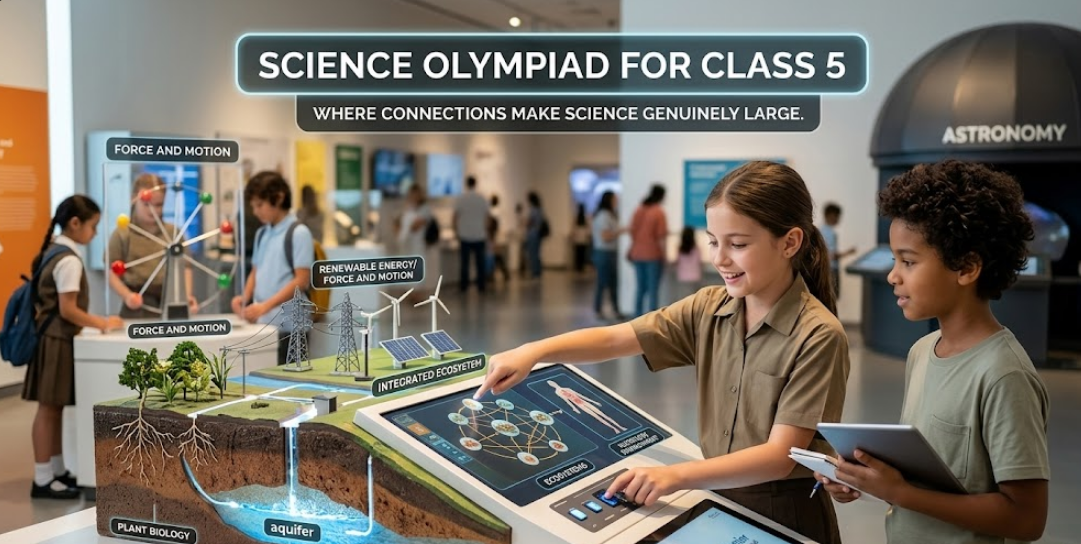
Something changes in the way children understand science during Class 5. Concepts no longer feel isolated or limited to individual chapters. Students begin to notice how different scientific ideas connect with each other in meaningful ways. They understand how plants rely on sunlight to produce food, how the water cycle influences weather, and how the human body connects directly to nutrition, health, and the environment. Science starts becoming larger, deeper, and far more interesting. A Science Olympiad for Class 5 supports students exactly at this stage of learning. It encourages them to think beyond memorisation and develop a more connected understanding of science and the world around them.
What Does a Science Olympiad for Class 5 Cover?
A Science Olympiad for Class 5 includes a wide range of topics that students already study in school. The syllabus commonly covers living organisms, ecosystems, food chains, the human body and its systems, matter and materials, force and motion, light and shadow, natural resources, environmental awareness, and the solar system.
The exam usually follows a multiple-choice format, but the questions are designed to test understanding rather than direct recall. Instead of asking students to simply define a scientific concept, the Olympiad encourages them to apply knowledge in practical situations. A question about ecosystems may require students to understand both plant life and animal behaviour together. Similarly, a question on force may present a real-life situation where students must apply the concept logically.
This style of questioning develops deeper scientific thinking and improves the ability to connect ideas across topics.
Why Class 5 Is an Important Stage for Science Learning
Class 5 often becomes a turning point in science education because students are mature enough to understand broader concepts and more detailed explanations. At this level, science is no longer only about learning facts. Students begin analysing relationships between ideas and understanding how scientific systems work together.
This deeper level of understanding becomes extremely valuable in higher classes, where concepts continue to grow more advanced. Students who build strong foundations in Class 5 usually approach future science topics with greater confidence and clarity.
A Science Olympiad helps strengthen these foundations by encouraging careful thinking, logical reasoning, and concept-based learning.
How a Science Olympiad Builds Independent Learning Skills
One of the biggest advantages of participating in a Science Olympiad during Class 5 is the development of independent study habits. At this stage, students are capable of taking more responsibility for their preparation. They begin identifying their own weak areas, managing practice schedules, and solving questions more independently.
This process helps students become more organised and disciplined learners. Instead of depending entirely on parents or teachers, they gradually learn how to approach academic challenges with confidence and responsibility.
These habits become extremely useful in higher classes, where subjects become more demanding and self-study becomes increasingly important.
Why Conceptual Understanding Matters More Than Memorisation
Science Olympiad questions are intentionally designed to reward understanding instead of rote learning. Students who memorise definitions without understanding concepts often struggle when questions are presented differently. On the other hand, students who understand the logic behind scientific ideas can solve unfamiliar problems more effectively.
This is why preparation should focus on building conceptual clarity. Students should try to understand why scientific events happen, how systems interact, and what causes specific outcomes. When children begin connecting concepts instead of studying chapters separately, science becomes far more engaging and meaningful.
How Parents Can Support Preparation
Parents can play an important role by encouraging curiosity and discussion rather than pressure. Simple conversations about weather, plants, motion, energy, or environmental issues can strengthen scientific thinking naturally. Asking children to explain concepts in their own words also helps improve understanding and confidence.
Sample papers are especially useful during preparation because they help students become familiar with Olympiad-style questions and improve analytical thinking. Most importantly, preparation should remain positive and enjoyable so that students continue developing genuine interest in science.
Also Read: EduJr Maths Olympiad for Class 6
Why the EduJunior Science Olympiad Is Valuable
The EduJunior Science Olympiad is designed to help students strengthen scientific understanding through logical thinking and application-based learning. The exam encourages students to move beyond memorisation and develop deeper conceptual clarity while building confidence in their problem-solving abilities.
Participating in the Olympiad also gives students the opportunity to experience healthy academic competition in a supportive and engaging environment.
Final Thoughts on Science Olympiad Class 5
A Science Olympiad for Class 5 is much more than an academic test. It is an opportunity for students to strengthen curiosity, improve analytical thinking, and develop a deeper understanding of scientific concepts.
At this stage, children begin seeing science not as isolated chapters but as connected ideas that explain the world around them. Encouraging that understanding early can shape stronger learning habits for years to come.
Register your child for the EduJunior Science Olympiad and let Class 5 become the year science turns into a subject they truly enjoy learning.