
 Nikhilesh Chavda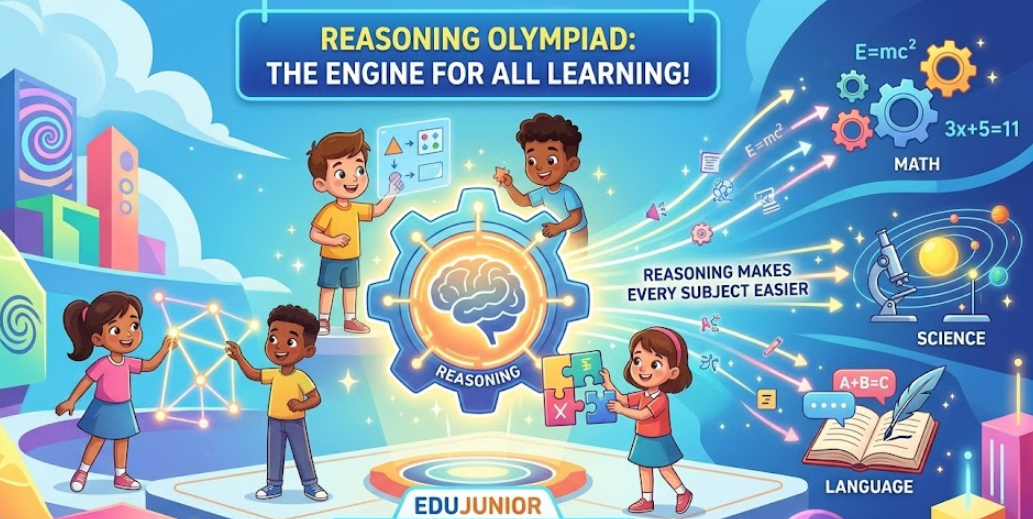
Most Olympiads focus on a single academic subject. Mathematics Olympiads test numerical ability, Science Olympiads evaluate scientific understanding, and English Olympiads assess grammar, vocabulary, and comprehension skills. A Reasoning Olympiad works differently.
Instead of testing how much a student has memorised, it evaluates how effectively a student can think. The focus is on logic, analysis, observation, and problem-solving. Students are expected to recognise patterns, process information carefully, and solve unfamiliar questions using reasoning rather than memorisation.
That is precisely why a Reasoning Olympiad is considered one of the most valuable academic competitions for students today.
What Does a Reasoning Olympiad Actually Test?
A Reasoning Olympiad measures a student’s ability to think systematically and arrive at logical conclusions. The exam is designed to evaluate intelligence in action rather than textbook recall.
The assessment is usually divided into two broad areas: verbal reasoning and non-verbal reasoning.
Verbal reasoning focuses on language-based thinking. Students may encounter analogies, classifications, coding-decoding questions, logical sequences, sentence completion, and relationship-based problems. These questions test how effectively students understand connections between words, ideas, and patterns.
Non-verbal reasoning, on the other hand, focuses on visual intelligence and spatial awareness. Students solve problems involving diagrams, figures, shapes, mirror images, and pattern sequences. Instead of relying on language, these questions measure observation skills and the ability to identify visual relationships quickly and accurately.
Although the formats differ, both sections assess the same core ability: solving unfamiliar problems through logical thinking.
Why Reasoning Skills Matter in Every Subject
Reasoning is not limited to Olympiad exams. It directly influences performance across all academic subjects. A student with strong reasoning ability approaches mathematics more confidently because they can break down complex problems step by step. In science, logical thinking helps students understand concepts instead of memorising definitions mechanically. During reading comprehension exercises, reasoning allows students to interpret deeper meaning and identify accurate conclusions.
This is why reasoning is often described as the foundation of effective learning. It improves how students analyse information, process instructions, and respond under pressure.
As modern education increasingly shifts toward application-based learning, reasoning skills have become more important than ever. Schools and educators now recognise Reasoning Olympiads as meaningful assessments of a student’s analytical and intellectual potential.
Can Reasoning Ability Be Improved?
One of the biggest misconceptions about reasoning is that it is purely natural talent. Many people assume that students are either born with strong logical ability or they are not. In reality, reasoning is a skill that improves with practice.
When students regularly solve different kinds of reasoning problems, their brains gradually become better at identifying structures, recognising patterns, and applying logical methods. Over time, they develop faster thinking speed and stronger analytical confidence. For example, students who practise analogy questions consistently begin recognising relationships more quickly. Those who work regularly on figure-based problems improve their spatial awareness and visual interpretation skills. Repeated exposure trains the mind to approach new questions calmly instead of feeling overwhelmed.
Short and consistent practice sessions are usually far more effective than long, irregular study schedules. Even fifteen to twenty minutes of focused reasoning practice every day can lead to noticeable improvement over time.
How Should Students Prepare for a Reasoning Olympiad?
Preparation for a Reasoning Olympiad is very different from preparing for a traditional school examination because there is no fixed syllabus to memorise. The most effective approach begins with understanding the different types of reasoning questions commonly asked in Olympiad exams. Instead of rushing through large numbers of questions, students should focus on understanding the logic behind every answer.
As preparation progresses, regular practice becomes essential. Solving varied problem types helps students become adaptable and comfortable with unfamiliar questions. Accuracy should be prioritised first, followed by speed improvement through timed practice sessions.
Sample papers also play an important role in preparation. They help students understand exam patterns, improve time management, and reduce anxiety before the actual competition. Reviewing incorrect answers is especially valuable because every mistake highlights a specific gap in logical thinking. Students who actively analyse their mistakes usually improve much faster than students who only focus on completing more questions.
The Long-Term Benefits of a Reasoning Olympiad
The benefits of participating in a Reasoning Olympiad extend far beyond certificates and rankings. Students gradually develop sharper analytical thinking, stronger concentration, and greater confidence while solving problems. They become more comfortable handling unfamiliar situations and learn how to think clearly under pressure.
These skills are not only useful in school examinations but also in competitive exams, higher education, and future careers. Logical thinking remains valuable throughout life because it strengthens decision-making, problem-solving, and intellectual confidence. A student who prepares seriously for a Reasoning Olympiad often becomes a better learner overall.
Why the EduJunior Reasoning Olympiad Matters
The EduJunior Reasoning Olympiad is designed to help students strengthen analytical thinking through structured and engaging competition.
Rather than encouraging rote learning, the exam focuses on helping students build practical reasoning skills that support long-term academic growth. It gives students an opportunity to challenge themselves, improve intellectual confidence, and experience healthy academic competition in a meaningful way.
Also Read: EduJr Spelling Bee Words
Final Thoughts
A Reasoning Olympiad is far more than just another academic exam. It is an opportunity for students to strengthen the thinking skills that influence success across every subject.
Students who develop strong reasoning ability often become faster learners, better problem-solvers, and more confident decision-makers. In today’s academic environment, where conceptual understanding matters more than memorisation, logical thinking has become an essential skill.
Register for the EduJunior Reasoning Olympiad and help your child build the one skill that makes every other subject easier.