
 Nikhilesh Chavda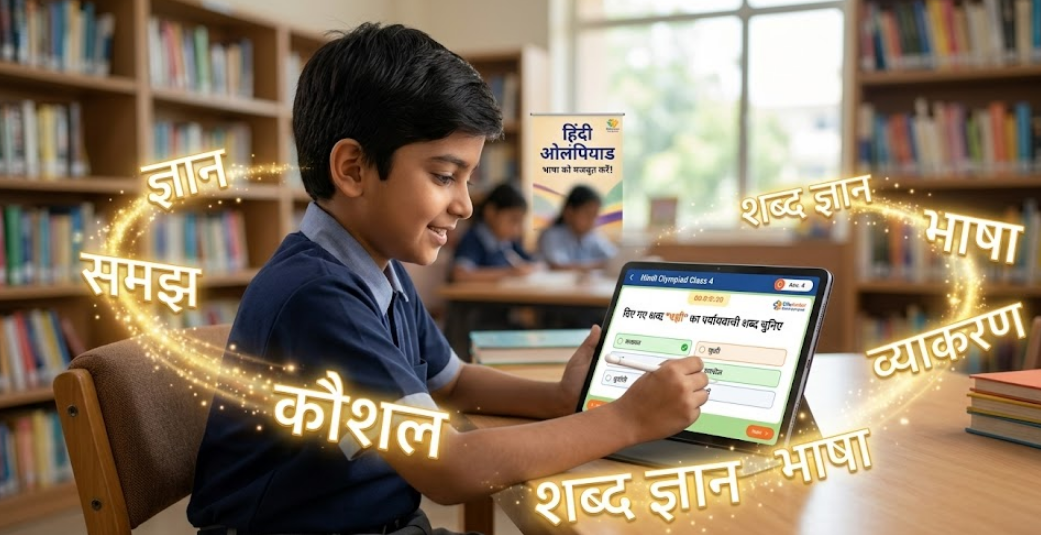
The Hindi Olympiad gives children an excellent opportunity to strengthen their language skills at the right stage of learning. By Class 4, most students are already comfortable speaking Hindi and reading short passages. However, this is also the stage where children begin moving from simple language usage to deeper comprehension, stronger grammar, and clearer written expression. That transition makes Class 4 the ideal time to participate in a Hindi Olympiad.
Many parents assume that because children speak Hindi at home, they will naturally become strong in the language. But speaking comfortably and truly mastering a language are very different things. A child may communicate fluently in Hindi yet still struggle with grammar accuracy, vocabulary, sentence formation, or reading comprehension.
The Hindi Olympiad Class 4 exam helps students strengthen these skills in a structured and engaging way while building confidence in their mother tongue.
What the Hindi Olympiad Exam Covers
The Hindi Olympiad Class 4 syllabus is based on concepts students already study in school. It includes reading comprehension, grammar, vocabulary, sentence formation, antonyms, synonyms, and basic verbal reasoning.
The exam is usually conducted in a multiple choice format within a fixed time limit. While the topics may appear familiar, the thinking required is very different from regular school examinations. In a standard school test, comprehension questions often focus only on direct information from a passage. Students may simply need to identify what happened or who said something. In the Hindi Olympiad exam, students are expected to interpret meaning, understand context, and choose the most accurate answer from closely related options.
This encourages children to read carefully, think critically, and improve their overall understanding of the language.
Why Class 4 Is the Right Age for Hindi Olympiad Preparation
Class 4 sits at an important point in a child’s academic development. Children are old enough to understand competition and feel motivated by achievement, yet young enough that preparation still feels enjoyable rather than stressful.
Participating in the Hindi Olympiad during Class 4 gives students a valuable head start before they enter higher classes where Hindi becomes more demanding. By Class 5 and Class 6, grammar concepts become more advanced, written answers require greater depth, and comprehension passages become more complex.
Students who prepare for the Hindi Olympiad Class 4 exam often enter higher classes with stronger reading ability, better vocabulary, and greater confidence in Hindi. They become more comfortable understanding passages, expressing ideas clearly, and applying grammar concepts correctly. Most importantly, they develop a positive relationship with their mother tongue at an early age.
Benefits of the Hindi Olympiad Class 4 Exam
Preparing for the Hindi Olympiad naturally improves vocabulary because students encounter new words through reading and practice. Instead of memorising definitions mechanically, children learn how words are used in real sentences and situations.
The preparation process also strengthens reading habits. Students who regularly read Hindi stories, articles, and short books gradually improve their comprehension skills and become more confident readers. Grammar accuracy improves naturally as students repeatedly practise sentence structures, word usage, and language patterns. Over time, children become more comfortable writing and speaking with clarity.
Another major benefit is confidence. Competitive exams encourage students to think independently and solve questions carefully. Children who participate in Olympiads often become more confident in classroom discussions and academic activities.
The Hindi Olympiad Class 4 exam also teaches students to value Hindi as an important language of learning, communication, and culture.
How to Prepare for Hindi Olympiad Class 4
The best way to prepare for the Hindi Olympiad Class 4 exam is through consistent reading. Children should regularly read Hindi storybooks, short stories, poems, and simple newspaper articles suitable for their age. Reading naturally improves vocabulary, comprehension, pronunciation, and familiarity with sentence structures.
Grammar preparation should focus on understanding concepts instead of memorising rules without context. Children should practise topics gradually and apply them through examples and exercises. Vocabulary building becomes much more effective when students learn words through stories and everyday usage rather than isolated memorisation. Practising synonyms, antonyms, and sentence formation regularly can make a noticeable difference.
In the final few weeks before the exam, solving sample papers helps students become comfortable with the question format and improve time management skills. Reviewing incorrect answers carefully also helps children understand concepts more clearly.
Parents should ensure the preparation process remains encouraging and balanced. Children at this age learn best when the experience feels positive and motivating.
Also Check Out: EduJr Art Competition
Building a Strong Hindi Foundation Early
Language skills developed during primary school often stay with children for years. A strong command of Hindi improves communication, comprehension, writing ability, and overall academic confidence.
The Hindi Olympiad Class 4 exam gives students an opportunity to strengthen these skills before academic pressure increases in higher classes. Instead of waiting for difficulties to appear later, students can develop strong fundamentals early and build confidence gradually.
Register your child for the EduJunior Hindi Olympiad at edujr.com and help them build strong Hindi skills from an early age.