
 Nikhilesh Chavda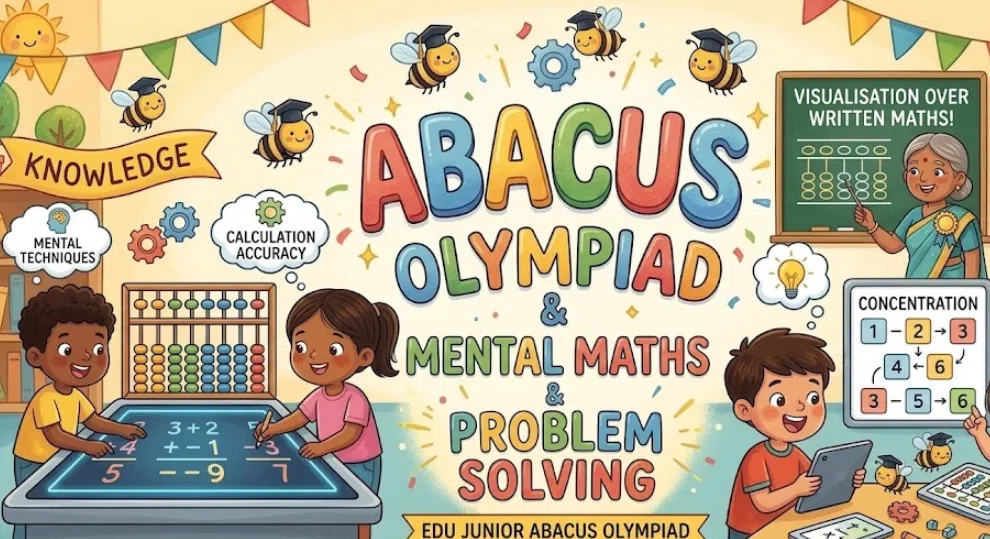
The phrase Abacus Olympiad often creates two very different reactions. Some parents believe it is meant only for children who are naturally brilliant with numbers and calculations. Many students, meanwhile, imagine an intimidating competition filled with impossible sums and extreme speed tests. Both assumptions are understandable. Both are also incorrect.
An Abacus Olympiad is not designed only for exceptionally gifted children. It is designed to test how well students understand mental maths techniques, concentration, calculation accuracy, and numerical reasoning under time pressure. For many children, preparing for an Abacus Olympiad becomes the moment when mathematics changes from slow written calculations to fast, confident mental problem solving.
What an Abacus Olympiad Actually Tests
An Abacus Olympiad is a structured competitive examination that evaluates mental arithmetic skills, concentration, speed, accuracy, and logical numerical thinking across different grade levels. The exam is usually time bound and divided into sections covering abacus calculations, mental maths, number operations, and reasoning based numerical questions.
Students are tested on topics such as addition, subtraction, multiplication, division, decimal calculations, number patterns, and visualisation techniques using abacus methods. Unlike routine school maths tests, Abacus Olympiad questions often require students to calculate quickly while maintaining high levels of accuracy and focus.
A question may involve multiple steps completed mentally within seconds. Instead of checking whether a student can slowly solve a problem using written methods, the exam measures how efficiently the student can process numbers mentally while staying calm under pressure.
That difference is what makes Abacus Olympiad preparation so valuable. Strong mental calculation skills play an important role in improving concentration, memory, and overall numerical confidence.
The Biggest Difference Between Strong and Weak Performance
Experienced trainers often notice one major difference between students who perform well in an Abacus Olympiad and those who struggle. Strong performers usually understand number patterns and visualisation techniques deeply. Other students often rely mainly on memorising procedures without developing mental clarity.
A child who genuinely understands how abacus methods work can adapt quickly when calculations become more complex. They can visualise numbers clearly and process calculations with confidence. A student who depends only on memorised finger movements without understanding the logic behind them often struggles when speed and pressure increase.
This is why Abacus Olympiad preparation benefits all students, even those who are not aiming for top rankings. The process itself strengthens concentration, improves memory, sharpens calculation speed, and builds confidence across school mathematics as well.
How Students Should Prepare for an Abacus Olympiad
Preparation should begin with a clear understanding of the student’s current skill level. Students should revise every major concept they have learned during abacus training and identify which calculation techniques feel strong and which areas still create hesitation. Weak areas deserve focused attention and repeated practice.
Mental calculation practice is especially important at every level. Many students struggle not because they lack ability, but because they lose concentration while solving problems under time pressure. Learning how to remain calm, visualise numbers clearly, and maintain accuracy during fast calculations is a skill that improves with regular practice.
Short daily practice sessions involving mental maths drills, number patterns, speed exercises, and visualisation activities help students become more comfortable with competitive exam conditions.
Focus and reading skills also matter more than many parents realise. Students who listen carefully, follow instructions properly, and stay mentally disciplined usually perform better because Abacus Olympiad questions often test concentration alongside calculation speed. Educational resources from EduJr and other mental maths learning platforms can also support concept based learning and practice.
Why Timed Practice Matters
In the final weeks before the Abacus Olympiad, students should begin solving full length practice papers under timed conditions.
This practice helps students improve time management, concentration, calculation speed, mental stamina, and exam confidence. Many children know how to solve calculations correctly but lose marks because they panic, lose focus, or spend too much time checking answers repeatedly.
Timed practice teaches students how to balance speed and accuracy while staying calm under pressure.
Also Check Out: EduJr Maths Olympiad for Class 5
Why an Abacus Olympiad Is Worth Attempting
The real value of an Abacus Olympiad extends far beyond certificates or rankings. Students who prepare seriously often become more focused thinkers. They learn how to approach calculations with confidence, maintain concentration for longer periods, and solve problems more efficiently under pressure.
That confidence carries into school exams, competitive tests, and many other academic situations.
More importantly, students begin to see mathematics differently. Instead of viewing maths as slow and difficult, they begin understanding it as something they can handle quickly, accurately, and confidently through strong mental skills and practice.
That shift in mindset can completely change a child’s relationship with numbers and learning.
Register your child for the EduJr Abacus Olympiad and help them build faster calculation skills, stronger concentration, and long term mathematical confidence.